
How to Calculate Area From Diameter Instead of Radius
Learn how to calculate area from diameter using simple formulas, step-by-step examples, direct diameter formulas, and common mistakes.
Calcifyai Team
Expert calculators & financial tools
Finding the area from diameter is easy once you know the relationship between diameter and radius.
The standard formula for the area of a circle uses the radius:
Area = π × radius × radius
But many real-world measurements give you the diameter instead. For example, you may know the diameter of a pizza, table, pipe, wheel, or circular garden and need to find its area.
The key relationship is:
Radius = Diameter ÷ 2
So the area can be calculated directly from the diameter using:
Area = π × (Diameter ÷ 2) × (Diameter ÷ 2)
or:
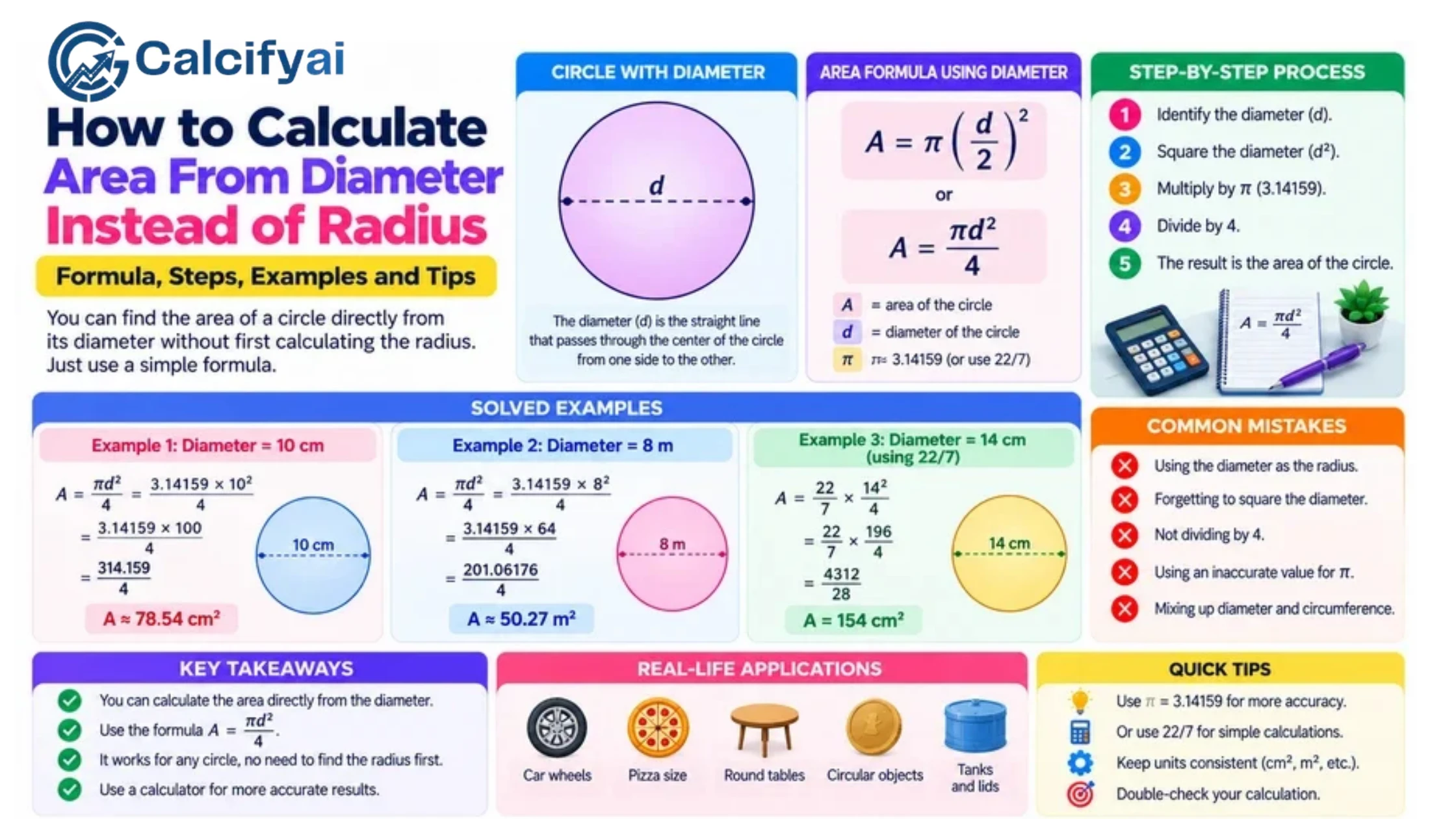
Area = π × Diameter² ÷ 4
NIST also gives the direct diameter-based form as Area = 0.7854 × diameter × diameter, which is the same relationship using an approximation for π. NIST
Radius vs. Diameter: What's the Difference?
Before calculating the area, it is important to understand these two measurements.
Radius
The radius is the distance from the center of a circle to its edge.
Diameter
The diameter is the distance across the entire circle through its center.
The relationship is:
Diameter = 2 × Radius
Therefore:
Radius = Diameter ÷ 2
For example, if a circle has a diameter of 20 cm:
Radius = 20 ÷ 2 = 10 cm
Formula for Area From Diameter
The standard circle area formula is:
Area = π × r²
But when you know the diameter, replace the radius with:
r = d ÷ 2
So:
Area = π × (d ÷ 2)²
This simplifies to:
Area = π × d² ÷ 4
Where:
Area = area of the circle
d = diameter
π ≈ 3.14159
When the diameter is given, divide it by 2 to find the radius before using the area formula. OpenStax provides a worked example of finding the area of a circle when the diameter is given.
How to Calculate Area From Diameter Step by Step
Use these simple steps.
Step 1: Find the diameter
Identify the full distance across the circle.
Step 2: Find the radius
Divide the diameter by 2.
Radius = Diameter ÷ 2
Step 3: Square the radius
Multiply the radius by itself.
Radius² = Radius × Radius
Step 4: Multiply by π
Use approximately 3.14159 unless the problem gives another value.
Area = π × Radius²
Step 5: Add square units
If the diameter is measured in centimeters, the area is in square centimeters.
Example 1: Diameter of 10 cm
Suppose a circle has a diameter of 10 cm.
Step 1: Find the radius
Radius = 10 ÷ 2
Radius = 5 cm
Step 2: Square the radius
5 × 5 = 25
Step 3: Multiply by π
Area = π × 25
Area ≈ 78.54 cm²
Answer
The area is approximately 78.54 cm².
Example 2: Diameter of 20 Inches
A circular table has a diameter of 20 inches. Find its area.
Step 1: Find the radius
20 ÷ 2 = 10 inches
Step 2: Use the area formula
Area = π × 10 × 10
Area = 100π
Step 3: Calculate
Area ≈ 314.16 square inches
Answer
The table has an area of approximately 314.16 in².
Example 3: Diameter of 16 Meters
Find the area of a circle with a diameter of 16 meters.
Step 1: Convert diameter to radius
16 ÷ 2 = 8 meters
Step 2: Square the radius
8 × 8 = 64
Step 3: Multiply by π
Area = 64π
Area ≈ 201.06 m²
Answer
The area is approximately 201.06 m².
Direct Formula: Area From Diameter
You do not always have to calculate the radius separately.
Use:
Area = π × d² ÷ 4
where d is the diameter.
For example, if:
d = 12 cm
Then:
Area = π × 12² ÷ 4
First square the diameter:
12² = 144
Then divide by 4:
144 ÷ 4 = 36
Then multiply by π:
36 × π ≈ 113.10
Answer
Area ≈ 113.10 cm²
This gives exactly the same result as finding the radius first.
Why Do We Divide the Diameter by 2?
The diameter stretches from one side of the circle to the other through the center.
The radius only goes from the center to one side.
Therefore, two radii make one diameter:
Radius + Radius = Diameter
So:
2 × Radius = Diameter
Rearranging gives:
Radius = Diameter ÷ 2
This is why you cannot simply put the diameter into π × r² without first converting it to a radius.
Comparing Diameter and Radius
Measurement | Meaning | Relationship |
|---|---|---|
Radius | Center to edge | r = d ÷ 2 |
Diameter | Edge to edge through center | d = 2r |
Area | Space inside circle | A = πr² |
Area from diameter | Area using diameter | A = πd² ÷ 4 |
The most important relationship to remember is:
d = 2r
How to Calculate Area Directly From Diameter
There is an even faster method when you already know the diameter.
Use:
Area = 0.7854 × Diameter × Diameter
For example, if the diameter is 10 cm:
Area = 0.7854 × 10 × 10
Area = 78.54 cm²
This is an approximation of:
Area = π × d² ÷ 4
The direct formula is useful when you are working with a calculator or doing repeated calculations.
How to Calculate Area From Diameter in a Word Problem
Word problems often provide the diameter instead of the radius.
Example
A circular garden has a diameter of 14 feet. How much ground does the garden cover?
Step 1: Identify the diameter
d = 14 ft
Step 2: Find the radius
r = 14 ÷ 2 = 7 ft
Step 3: Calculate the area
Area = π × 7 × 7
Area = 49π
Step 4: Approximate
Area ≈ 153.94 ft²
Answer
The garden covers approximately 153.94 square feet.
How to Calculate Area From Diameter Without Finding the Radius
You can also solve the same problem directly.
Given:
d = 14 ft
Use:
Area = π × d² ÷ 4
Substitute:
Area = π × 14² ÷ 4
Square the diameter:
14² = 196
Divide by 4:
196 ÷ 4 = 49
Then:
Area = 49π
Area ≈ 153.94 ft²
Both approaches produce the same answer.
Area From Diameter vs. Circumference From Diameter
Do not confuse these two formulas.
Area
Area = π × d² ÷ 4
Area measures the space inside the circle.
Circumference
Circumference = π × d
Circumference measures the distance around the circle.
For example, if the diameter is 10 cm:
Area ≈ 78.54 cm²
while:
Circumference ≈ 31.42 cm
The units also help distinguish them:
Area → square units
Circumference → linear units
Using a Circle Calculator
If you know the diameter and want to quickly find the area, radius, or circumference, you can use the Circle Calculator.
It accepts a known circle measurement and can calculate the other measurements, including area from diameter.
This is useful for checking manual calculations or working with measurements that require several steps.
Common Mistakes When Finding Area From Diameter
1. Using the Diameter as the Radius
Suppose the diameter is 12 cm.
The radius is:
12 ÷ 2 = 6 cm
Do not use 12 directly in:
Area = π × r²
2. Forgetting to Square the Radius
The formula is:
Area = π × r²
That means:
r × r
not simply:
π × r
For a radius of 5:
5² = 25
3. Using the Circumference Formula
If you need area, use:
Area = π × r²
or:
Area = π × d² ÷ 4
Do not use:
C = πd
That formula finds circumference.
4. Forgetting Square Units
If the diameter is measured in meters, the answer should be in:
m²
not:
m
Area measures two-dimensional space, so its units are squared.
5. Rounding Too Early
Keep extra decimal places during the calculation and round at the end.
For example, using 3.14 instead of a more precise value of π can produce a slightly different answer.
If the problem specifies a particular value of π, follow that instruction.
How Does Diameter Affect Circle Area?
The diameter has a squared effect on area.
The formula is:
Area = π × d² ÷ 4
This means that if the diameter doubles, the area becomes four times larger.
For example:
Diameter = 10
Area = 25π
Diameter = 20
Area = 100π
The diameter doubled, but the area became four times as large.
This is because:
2² = 4
This relationship is useful when comparing circular objects of different sizes.
Real-Life Uses of Area From Diameter
Knowing how to calculate area from diameter can be useful in many situations.
Circular tables
If you know the table's diameter, you can estimate its surface area.
Pizza
Pizza sizes are commonly described by diameter. Area calculations show how much surface is available.
Pipes
The diameter of a circular opening can be used to determine its cross-sectional area.
Circular gardens
A diameter measurement can help determine the amount of ground covered.
Wheels
The diameter can be used to calculate the area of the circular face.
Round pools
Knowing the diameter helps determine the surface area of the pool.
Quick Reference
Given Diameter | Radius | Area |
|---|---|---|
2 | 1 | 3.14 |
4 | 2 | 12.57 |
6 | 3 | 28.27 |
8 | 4 | 50.27 |
10 | 5 | 78.54 |
12 | 6 | 113.10 |
14 | 7 | 153.94 |
20 | 10 | 314.16 |
The area values are approximate and use π ≈ 3.14159.
Frequently Asked Questions
What is the formula for area from diameter?
The direct formula is:
Area = π × Diameter² ÷ 4
You can also find the radius first:
Radius = Diameter ÷ 2
Then use:
Area = π × Radius²
How do you find the area of a circle when only the diameter is given?
Divide the diameter by 2 to find the radius. Then square the radius and multiply it by π.
For example, a diameter of 10 gives a radius of 5:
Area = π × 5² ≈ 78.54 square units
Can I calculate circle area without finding the radius?
Yes. Use:
Area = π × d² ÷ 4
where d is the diameter.
What is the area of a circle with a diameter of 10?
The radius is 5.
Area = π × 5²
Area ≈ 78.54 square units
Is diameter twice the radius?
Yes.
Diameter = 2 × Radius
Therefore:
Radius = Diameter ÷ 2
What happens to area if the diameter doubles?
The area becomes four times larger because area depends on the square of the diameter.
Should I use 3.14 for π?
You can use 3.14 when the problem instructs you to or when an approximate answer is acceptable. Otherwise, use the π function on a calculator and round the final answer as required.
What units should area use?
Area is always expressed in square units. For example:
Diameter in inches → area in in²
Diameter in feet → area in ft²
Diameter in centimeters → area in cm²
Diameter in meters → area in m²
Final Takeaway
When you know the diameter instead of the radius, finding the area of a circle only requires one extra step.
Remember:
Radius = Diameter ÷ 2
Then:
Area = π × Radius²
Or go directly to:
Area = π × Diameter² ÷ 4
For example, if the diameter is 12 cm:
Radius = 12 ÷ 2 = 6 cm
Area = π × 6²
Area ≈ 113.10 cm²
The biggest mistakes to avoid are using the diameter as the radius, forgetting to square the radius, confusing area with circumference, and leaving the answer in linear rather than square units.
Disclaimer
The information provided in this article is for educational and informational purposes only. It should not be considered as professional financial, medical, or legal advice. Always consult with qualified professionals for specific guidance related to your situation.
Popular Calculators
Explore our most-used free calculators for finance, health, and everyday needs.