
Does Your Name Really Affect Love Compatibility?
Does your name affect love compatibility? Discover how name matching works, whether love calculators are accurate, and what really matters in a relationship.
Calcifyai Team
Expert calculators & financial tools
Name compatibility is a popular way to explore romantic connections. From comparing two names to checking a love percentage online, many people enjoy seeing whether their names seem like a good match. But does your name really affect love compatibility?
The short answer is no: there is no reliable scientific evidence that the letters in two people's names determine their romantic compatibility or predict whether their relationship will last. Name compatibility tests and love calculators can be entertaining, but real relationships depend on much more than names.
Your name may have personal meaning, cultural importance, or a special story behind it. However, a name-based score cannot tell you whether you and another person share values, communicate well, trust each other, or want similar things from life.
Let's look at how name compatibility works, why people enjoy it, and what matters more when building a meaningful relationship.
What Is Name Compatibility?
Name compatibility is the idea that two people's names can be compared to estimate how well they match romantically. It is often used in online love calculators, name matching games, numerology readings, and relationship quizzes.
These tools may compare letters, count shared characters, or use a simple calculation to produce a love percentage.
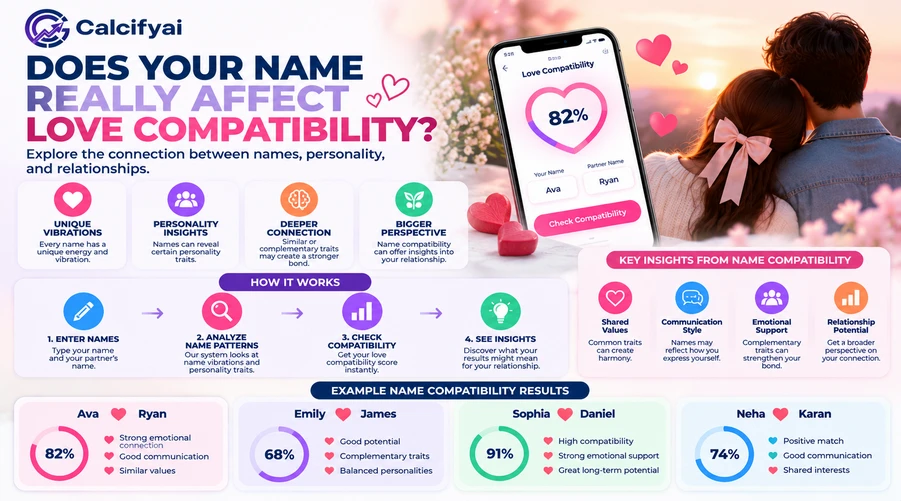
For example, imagine two people named Alex and Sam. A name compatibility calculator might process their names and display a result such as 78%.
That number can be fun to share with a partner or friends. But it does not mean the couple has a 78% chance of falling in love or staying together.
How Does Name Compatibility Work?
Different name compatibility tools use different methods. Common approaches include:
Letter matching: Comparing the letters in two names and counting shared characters.
Numerology: Assigning numbers to letters and interpreting the resulting values.
Name-based algorithms: Applying a programmed formula to names to generate a percentage.
Random or playful scoring: Producing a score mainly for entertainment.
There is no single scientific formula for name compatibility. The result depends on the method used by the particular tool.
A love calculator may give the same result every time you enter the same names because its algorithm is consistent. That consistency does not make the score a scientifically validated measure of love.
Can Your Name Influence Romantic Attraction?
Your name can be part of your identity and may influence how people remember or recognize you. Names can also carry cultural, family, and personal associations.
However, that is different from saying that a name determines romantic attraction or relationship success.
For example, someone might feel a special connection to a name because it reminds them of a family member, a childhood friend, or a person they once admired. These are personal associations, not proof that two names are naturally compatible.
Attraction develops through a mix of individual preferences, experiences, emotions, and interactions. A name alone cannot reveal how two people will connect.
Why Do People Believe in Name Matching?
There are several reasons name matching remains popular:
Curiosity: People naturally enjoy discovering whether they might be a good match with someone they like.
Entertainment: A love percentage can turn a simple conversation into a playful activity.
Personal meaning: Names may have emotional, cultural, or spiritual significance.
Confirmation bias: People may remember results that match what they already hope or believe.
Social sharing: Compatibility scores are easy to send to a crush, partner, or group of friends.
These reasons help explain why name compatibility tests can feel meaningful, even though their scores do not measure real romantic compatibility.
What Actually Determines Love Compatibility?
A strong relationship is shaped by how two people treat each other and how well their needs and expectations fit together. A name-based score cannot measure these real-life factors.
1. Shared Values
Values influence important choices about family, finances, commitment, lifestyle, and the future.
Two people do not need identical beliefs to build a good relationship. However, it helps when they can understand each other's priorities and work through major differences.
2. Communication
Healthy communication means being able to express thoughts and feelings, listen carefully, and discuss difficult subjects with respect.
For example, if one person prefers to talk through a disagreement immediately while the other needs time to think, they can discuss a routine that respects both needs.
3. Trust and Respect
Trust grows when people are honest, dependable, and respectful of each other's boundaries. It is built through actions over time, not through matching names.
Respect also means accepting that each person has their own interests, friendships, opinions, and personal space.
4. Emotional Understanding
People express affection and handle emotions in different ways. One person may appreciate frequent reassurance, while another may show care by helping with everyday tasks.
Understanding these differences can help partners feel supported. Emotional compatibility is not about reacting in exactly the same way; it is about learning how to respond to each other's needs.
5. Similar Expectations for the Future
Long-term plans can influence how well two people fit together. Topics such as marriage, children, career choices, finances, and where to live may deserve honest conversations.
Partners do not have to agree on every detail from the beginning. What matters is whether they can discuss their expectations and find a path that works for both.
Research involving couples has also examined how trust relates to relationship satisfaction. A study published in Personal Relationships found that trust helped explain the connection between insecure romantic attachment and relationship satisfaction in the couples studied. Read the research on attachment, trust, and relationship satisfaction
For a deeper look at these factors, read our guide on what makes two people compatible in a relationship.
How to Check Name Compatibility for Fun
If you enjoy name matching, you can try it as a lighthearted activity. Just remember that the result is not a relationship prediction.
Follow these simple steps:
Step 1: Enter Both Names
Choose the names you want to compare. You can use first names, full names, or nicknames, depending on the calculator.
Step 2: Generate a Compatibility Score
Use a name-based love calculator to see the percentage it generates. Different tools may produce different results because they use different formulas.
Step 3: Treat the Result as Entertainment
A high score does not prove that two people are meant to be together. A low score does not mean a relationship is unlikely to work.
You can try the CalcifyAI Love Calculator to compare two names and get a playful love percentage.
Step 4: Focus on Your Real Connection
If you are genuinely interested in someone, spend time getting to know them. Notice how you communicate, whether you feel comfortable being yourself, and how you handle differences.
Those experiences can tell you much more about a relationship than a name-matching result.
Common Myths About Name Compatibility
Some popular beliefs about name matching can make a playful test seem more meaningful than it is.
Myth 1: A High Love Percentage Means You Are Soulmates
A high percentage is simply the result produced by a calculator's formula. It does not confirm that two people are soulmates or predict their future together.
Myth 2: Names With Similar Letters Are More Compatible
Two names may share several letters, but that does not establish that the people who have those names will have similar personalities, values, or relationship goals.
Myth 3: A Low Score Means a Relationship Will Fail
A low score should not be treated as a warning about a real relationship. Name-based tools do not have a validated way to predict whether a couple will succeed.
Myth 4: Changing a Name Can Improve Love Compatibility
Changing a nickname or spelling may change the result from a name-based calculator. It does not provide evidence that a person's romantic compatibility has changed.
Myth 5: Name Compatibility Is the Same as Numerology
Name compatibility calculators may use numerology-inspired ideas, but not all tools use numerology. Some simply compare letters or apply other programmed rules. Neither approach has been established as a scientific way to measure romantic compatibility.
Frequently Asked Questions
Does your name really affect love compatibility?
There is no reliable scientific evidence that the letters or spelling of your name determine romantic compatibility. Your name may have personal or cultural meaning, but a healthy relationship depends on how two people connect and treat each other.
Is name compatibility scientifically proven?
No. Name-based love percentages and letter-matching methods are not scientifically validated measures of romantic compatibility. They are best viewed as entertainment.
How accurate are online name compatibility tests?
Their accuracy as relationship predictors has not been established. A calculator may consistently produce the same score for the same names, but that only shows how its algorithm works. It does not prove that the score reflects real compatibility.
Can two people with completely different names be compatible?
Yes. Names do not need to sound alike or share letters for two people to form a meaningful relationship. Communication, trust, respect, shared values, and compatible expectations are more relevant to how a relationship works.
Do love calculators predict marriage or long-term relationships?
No. A love calculator cannot reliably predict marriage, commitment, or how long a relationship will last. These outcomes depend on real-life choices, circumstances, and the experiences of the people involved.
Should I trust a name compatibility percentage?
Treat it as a fun result rather than advice for making relationship decisions. A percentage cannot tell you whether someone respects your boundaries, communicates honestly, or shares your important goals.
Conclusion
Name compatibility can be a fun way to explore romantic curiosity, compare names, and share a playful result with someone you like. But your name does not determine whom you love or whether a relationship will succeed.
A meaningful connection grows through trust, communication, emotional understanding, respect, and shared expectations. Instead of relying on a percentage to judge a relationship, pay attention to how you feel around the other person and how you treat each other over time.
Enjoy name matching for fun, but let real experiences, not a calculator score, guide your understanding of love.
Disclaimer
The information provided in this article is for educational and informational purposes only. It should not be considered as professional financial, medical, or legal advice. Always consult with qualified professionals for specific guidance related to your situation.
Popular Calculators
Explore our most-used free calculators for finance, health, and everyday needs.