
How to Calculate Work Hours for an Overnight Shift
Learn how to calculate overnight shift hours across midnight, subtract breaks, convert time to decimals, and avoid common timesheet mistakes.
Calcifyai Team
Expert calculators & financial tools
Calculating work hours for an overnight shift can be confusing because the shift crosses midnight.
For example, if you work from 10:00 PM to 6:00 AM, you cannot simply subtract 10 from 6. The shift starts on one calendar day and ends on the next.
The easiest approach is to split the shift at midnight, calculate each part separately, and then add the hours together.
For a 10:00 PM to 6:00 AM shift:
10:00 PM to midnight = 2 hours
Midnight to 6:00 AM = 6 hours
Total = 8 hours
If you have an unpaid break, subtract it from the total.
This guide explains how to calculate overnight shift hours manually, how to handle breaks, how to convert the result to decimal hours, and how to avoid common timesheet mistakes.
What Is an Overnight Shift?
An overnight shift is a work period that starts on one day and ends on the following day.
Common examples include:
8:00 PM to 4:00 AM
9:00 PM to 5:00 AM
10:00 PM to 6:00 AM
11:00 PM to 7:00 AM
12:00 AM to 8:00 AM
The important feature is that the shift crosses midnight.
For example:
10:00 PM → 6:00 AM
The employee starts work at night and finishes in the morning of the next calendar day.
How to Calculate Overnight Shift Hours
The simplest method is to divide the shift into two sections:
Time before midnight
Time after midnight
Then add both sections together.
Example: 10 PM to 6 AM
Suppose your shift is:
Start: 10:00 PM
End: 6:00 AM
Step 1: Calculate the Time Before Midnight
From 10:00 PM to midnight:
2 hours
Step 2: Calculate the Time After Midnight
From midnight to 6:00 AM:
6 hours
Step 3: Add the Two Periods
2 + 6 = 8 hours
So, the overnight shift is:
8 hours
Overnight Shift With an Unpaid Break
If your shift includes an unpaid break, subtract that break from the total shift time.
For example:
Start: 9:00 PM
End: 5:00 AM
Unpaid break: 30 minutes
First calculate the full shift.
Before Midnight
9:00 PM to midnight:
3 hours
After Midnight
Midnight to 5:00 AM:
5 hours
Total Shift Time
3 + 5 = 8 hours
Now subtract the 30-minute break:
8 hours − 30 minutes = 7 hours 30 minutes
Your net work time is:
7 hours 30 minutes
In decimal form:
7.5 hours
Whether a particular break is counted as hours worked depends on the type of break and applicable employment rules. Under U.S. federal guidance, short breaks are generally treated differently from bona fide meal periods. The U.S. Department of Labor provides more detail in its guidance on breaks and meal periods.
Overnight Shift Hours Formula
For an overnight shift, you can use a simple approach:
Overnight Work Hours = Hours Before Midnight + Hours After Midnight − Unpaid Breaks
For example:
10:00 PM to midnight = 2 hours
Midnight to 7:00 AM = 7 hours
Total:
2 + 7 = 9 hours
If there is a 30-minute unpaid break:
9 − 0.5 = 8.5 hours
The employee worked:
8 hours 30 minutes
or
8.5 decimal hours
How to Calculate an Overnight Shift Step by Step
Let's use a more detailed example.
Suppose an employee works:
Start: 8:30 PM
End: 5:30 AM
Unpaid break: 45 minutes
Step 1: Calculate the Evening Portion
From 8:30 PM to midnight:
3 hours 30 minutes
Step 2: Calculate the Morning Portion
From midnight to 5:30 AM:
5 hours 30 minutes
Step 3: Add the Two Portions
3 hours 30 minutes + 5 hours 30 minutes = 9 hours
Step 4: Subtract the Break
9 hours − 45 minutes = 8 hours 15 minutes
So, the employee worked:
8 hours 15 minutes
How to Calculate an Overnight Shift Without Splitting at Midnight
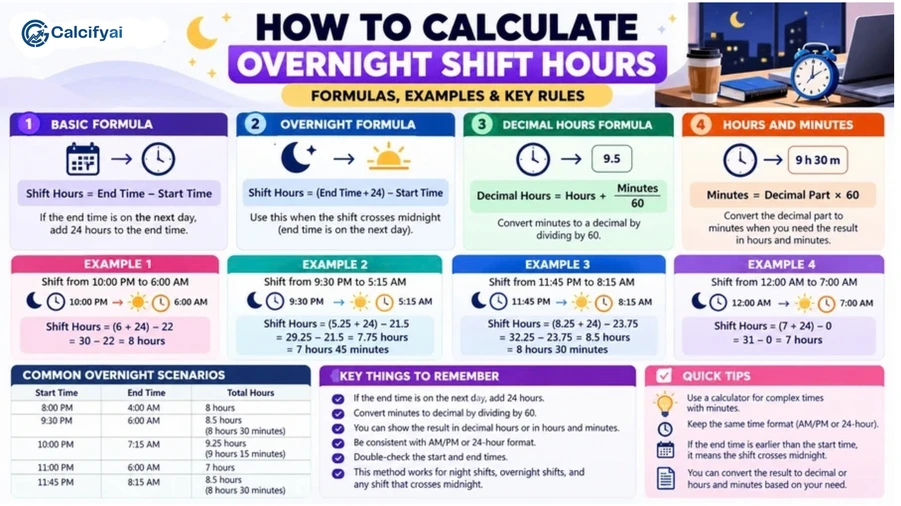
You can also calculate overnight hours using a 24-hour clock.
For example:
Start: 10:00 PM = 22:00
End: 6:00 AM = 06:00
Because 06:00 is earlier than 22:00, the ending time belongs to the next day.
Add 24 hours to the ending time:
06:00 + 24:00 = 30:00
Then subtract:
30:00 − 22:00 = 8 hours
So the shift is:
8 hours
This method can be useful for spreadsheets, payroll systems, and programming because it makes the date change explicit.
How to Calculate Overnight Hours With Minutes
Minutes can make overnight calculations slightly more difficult.
Consider:
Start: 9:45 PM
End: 6:15 AM
Before Midnight
9:45 PM to midnight:
2 hours 15 minutes
After Midnight
Midnight to 6:15 AM:
6 hours 15 minutes
Add them:
2 hours 15 minutes + 6 hours 15 minutes = 8 hours 30 minutes
So the total shift is:
8 hours 30 minutes
If there is a 30-minute unpaid break:
8 hours 30 minutes − 30 minutes = 8 hours
The actual work time is:
8 hours
How to Convert Overnight Shift Hours to Decimal Hours
Many timesheets and payroll systems use decimal hours instead of hours and minutes.
To convert minutes into decimal hours:
Decimal Minutes = Minutes ÷ 60
For example:
30 minutes ÷ 60 = 0.50 hours
Therefore:
8 hours 30 minutes = 8.5 hours
Some common conversions are:
Hours and Minutes | Decimal Hours |
|---|---|
8 hours 0 minutes | 8.00 |
8 hours 15 minutes | 8.25 |
8 hours 30 minutes | 8.50 |
8 hours 45 minutes | 8.75 |
9 hours 0 minutes | 9.00 |
A common mistake is writing 8 hours 30 minutes as 8.30 hours. That is incorrect for decimal-hour calculations.
Thirty minutes represents half of an hour, so the correct value is 8.50 hours.
How to Calculate Overnight Hours for Payroll
Payroll calculations often require the actual number of hours worked rather than simply the time between clock-in and clock-out.
Suppose an employee works:
10:00 PM to 6:30 AM
with a:
30-minute unpaid break
First calculate the total shift:
10:00 PM to midnight = 2 hours
Midnight to 6:30 AM = 6 hours 30 minutes
Total:
8 hours 30 minutes
Subtract the break:
8 hours 30 minutes − 30 minutes = 8 hours
The employee's net work time is:
8.00 hours
The exact treatment of breaks, overtime, and other payroll items depends on the applicable workplace rules and jurisdiction.
How to Calculate Weekly Hours From Overnight Shifts
If you work the same overnight schedule several days per week, calculate each shift and then add the results.
Suppose an employee works:
10:00 PM to 6:00 AM
for five nights.
Each shift:
8 hours
Weekly total:
8 × 5 = 40 hours
So the employee worked:
40 hours
Example With Breaks
Suppose each shift has a 30-minute unpaid break.
Each shift:
8 hours − 0.5 hours = 7.5 hours
For five shifts:
7.5 × 5 = 37.5 hours
The weekly total is:
37.5 hours
Overnight Shift That Starts and Ends on Different Dates
When recording an overnight shift on a timesheet, the date can matter as much as the time.
For example:
Monday 10:00 PM to Tuesday 6:00 AM
This is an 8-hour shift, but it crosses two calendar dates.
A good timesheet should clearly identify the start and end dates so that the work period is not accidentally recorded as occurring entirely on Monday or Tuesday.
For payroll and employment records, follow your employer's timekeeping system and applicable rules.
What If the Overnight Shift Is More Than 12 Hours?
The same basic calculation still works.
For example:
6:00 PM to 7:00 AM
Before Midnight
6:00 PM to midnight:
6 hours
After Midnight
Midnight to 7:00 AM:
7 hours
Total:
6 + 7 = 13 hours
If there is a one-hour unpaid break:
13 − 1 = 12 hours
The net work time is:
12 hours
Long shifts may involve additional workplace, safety, or legal requirements depending on the job and location.
Overnight Shift vs. Regular Shift
The main difference is whether the shift crosses midnight.
A regular daytime shift might be:
9:00 AM to 5:00 PM
Calculation:
5:00 PM − 9:00 AM = 8 hours
An overnight shift might be:
10:00 PM to 6:00 AM
Because the shift crosses midnight, split it into two parts:
10:00 PM to midnight = 2 hours
Midnight to 6:00 AM = 6 hours
Total:
8 hours
The basic goal is the same: determine the elapsed time and subtract applicable unpaid breaks.
Common Overnight Shift Examples
8 PM to 4 AM
Before midnight:
8 PM to midnight = 4 hours
After midnight:
Midnight to 4 AM = 4 hours
Total:
8 hours
9 PM to 5 AM
Before midnight:
3 hours
After midnight:
5 hours
Total:
8 hours
11 PM to 7 AM
Before midnight:
1 hour
After midnight:
7 hours
Total:
8 hours
7 PM to 7 AM
Before midnight:
5 hours
After midnight:
7 hours
Total:
12 hours
With a one-hour unpaid break:
12 − 1 = 11 hours
How to Calculate Overnight Shifts With Multiple Breaks
If your shift includes more than one break, add the applicable break times before subtracting them.
For example:
Start: 9:00 PM
End: 6:00 AM
Breaks:
30-minute meal break
15-minute unpaid break
First calculate the full shift:
9:00 PM to midnight = 3 hours
Midnight to 6:00 AM = 6 hours
Total:
9 hours
Total breaks:
30 + 15 = 45 minutes
Net work time:
9 hours − 45 minutes = 8 hours 15 minutes
So the employee worked:
8.25 hours
Always confirm whether each break should actually be deducted under your workplace's timekeeping rules.
Using an Overnight Shift Hours Calculator
Manually calculating overnight shifts is easy when you have only one or two shifts. It can become more time-consuming when you regularly work nights, have different schedules, or need to calculate weekly totals.
A dedicated overnight shift hours calculator can help you calculate the time between start and end times while accounting for breaks.
You can use the Work Hours Calculator to calculate daily and weekly work hours, account for breaks, and review regular or overtime hours.
When entering an overnight shift, make sure you select the correct AM and PM values.
For example:
Start: 10:00 PM
End: 6:00 AM
Do not enter 6:00 PM by mistake, because that represents a completely different shift.
Overnight Shifts and Multiple Work Periods
Some employees work more than one period during a day or week.
For example:
Overnight shift: 10:00 PM to 6:00 AM
Additional shift: 2:00 PM to 5:00 PM
Calculate each work period separately.
Overnight shift:
8 hours
Afternoon shift:
3 hours
Total:
8 + 3 = 11 hours
For more complex schedules involving multiple shifts, split shifts, overnight work, and weekly totals, see this guide on calculating hours worked across multiple shifts.
Common Mistakes When Calculating Overnight Shift Hours
Mistake 1: Subtracting the Clock Numbers Directly
A common mistake is:
6 − 10 = −4
This does not represent the length of a 10 PM to 6 AM shift.
The shift crosses midnight, so you need to account for the next day.
Mistake 2: Forgetting Midnight
Always identify whether the shift crosses midnight.
For example:
10 PM to 6 AM
is not a same-day shift.
Mistake 3: Forgetting Unpaid Breaks
If a break should not be counted as work time, subtract it from the shift total.
Mistake 4: Treating Minutes as Decimal Numbers
Thirty minutes is:
0.50 hours
not:
0.30 hours
Mistake 5: Using the Wrong AM or PM
Entering 6:00 PM instead of 6:00 AM can completely change the result.
Always double-check AM and PM.
Mistake 6: Rounding Too Early
Keep the original hours and minutes during the calculation. Convert to decimal hours after determining the total when possible.
Mistake 7: Ignoring the Date
An overnight shift can begin on one date and finish on the next.
Recording both dates correctly can help prevent timesheet errors.
Are Overnight Hours Automatically Overtime?
No. Working overnight does not automatically mean that every hour is overtime.
Under the U.S. Fair Labor Standards Act, covered non-exempt employees generally receive overtime at not less than one and one-half times their regular rate for hours worked over 40 in a workweek. However, overtime rules can vary by jurisdiction and employment situation.
Night-shift premiums are also not automatically required under U.S. federal law. They may depend on an employer agreement, contract, or other applicable rules.
Therefore, calculate the actual hours first, then apply the rules relevant to your employment situation.
Frequently Asked Questions
How do I calculate overnight shift hours?
Split the shift at midnight, calculate the hours before and after midnight, and add them together. Then subtract any applicable unpaid breaks.
For example:
10 PM to midnight = 2 hours
Midnight to 6 AM = 6 hours
Total = 8 hours
How many hours is 10 PM to 6 AM?
A shift from 10:00 PM to 6:00 AM is 8 hours before any break deductions.
How many hours is 9 PM to 5 AM?
A shift from 9:00 PM to 5:00 AM is 8 hours before any break deductions.
How many hours is 11 PM to 7 AM?
A shift from 11:00 PM to 7:00 AM is 8 hours before any break deductions.
How do I calculate an overnight shift with a 30-minute break?
First calculate the full shift, then subtract 30 minutes.
For example:
10 PM to 6 AM = 8 hours
8 hours − 30 minutes = 7 hours 30 minutes
In decimal form, that is 7.5 hours.
What is 30 minutes in decimal hours?
Thirty minutes equals:
30 ÷ 60 = 0.50 hours
Therefore, 30 minutes is 0.50 decimal hours.
How do I calculate weekly overnight shift hours?
Calculate each overnight shift separately and add the results.
For example, if each shift is 8 hours and you work five shifts:
8 × 5 = 40 hours
If each shift includes a 30-minute unpaid break:
7.5 × 5 = 37.5 hours
Does an overnight shift count as two workdays?
An overnight shift crosses two calendar dates, but that does not automatically mean the shift should be treated as two separate work shifts.
How the hours are recorded for payroll, overtime, and workweeks depends on the applicable timekeeping system and employment rules.
Is 10 PM to 6 AM an 8-hour shift?
Yes. From 10 PM to midnight is 2 hours, and midnight to 6 AM is 6 hours.
2 + 6 = 8 hours
Any applicable unpaid break would be deducted from those 8 hours.
What is the easiest way to calculate overnight work hours?
The easiest manual method is to split the shift at midnight. For repeated calculations, an overnight shift hours calculator can make the process faster and reduce common time-entry mistakes.
Final Takeaway
Calculating work hours for an overnight shift is simple once you account for midnight.
The basic process is:
Record the start and end times.
Determine whether the shift crosses midnight.
Calculate the hours before midnight.
Calculate the hours after midnight.
Add both periods.
Subtract applicable unpaid breaks.
Convert the final result to decimal hours if needed.
Check the dates and AM/PM values on the timesheet.
For example:
10:00 PM to midnight = 2 hours
Midnight to 6:00 AM = 6 hours
Total = 8 hours
With a 30-minute unpaid break:
8 − 0.5 = 7.5 hours
Once you use the midnight-split method, even irregular overnight schedules become much easier to calculate accurately.
Disclaimer
The information provided in this article is for educational and informational purposes only. It should not be considered as professional financial, medical, or legal advice. Always consult with qualified professionals for specific guidance related to your situation.
Popular Calculators
Explore our most-used free calculators for finance, health, and everyday needs.