
How to Calculate Wall Area for Paint, Wallpaper, or Tiles
Learn how to calculate wall area for paint, wallpaper, or tiles with simple formulas, step-by-step examples, and material estimation tips.
Calcifyai Team
Expert calculators & financial tools
Planning to paint a room, install wallpaper, or cover a wall with tiles? Before buying materials, you need to know how much wall space you have. Calculating wall area helps you estimate the amount of paint, wallpaper, or tile required and avoid purchasing too much or too little.
The good news is that you can calculate wall area by multiplying each wall’s width by its height and adding the results together. For a more accurate estimate, subtract the area of doors, windows, and other openings that will not be covered.
In this guide, you’ll learn how to calculate wall area step by step, with simple formulas, practical examples, and tips for estimating materials for different home improvement projects.
How to Calculate Wall Area
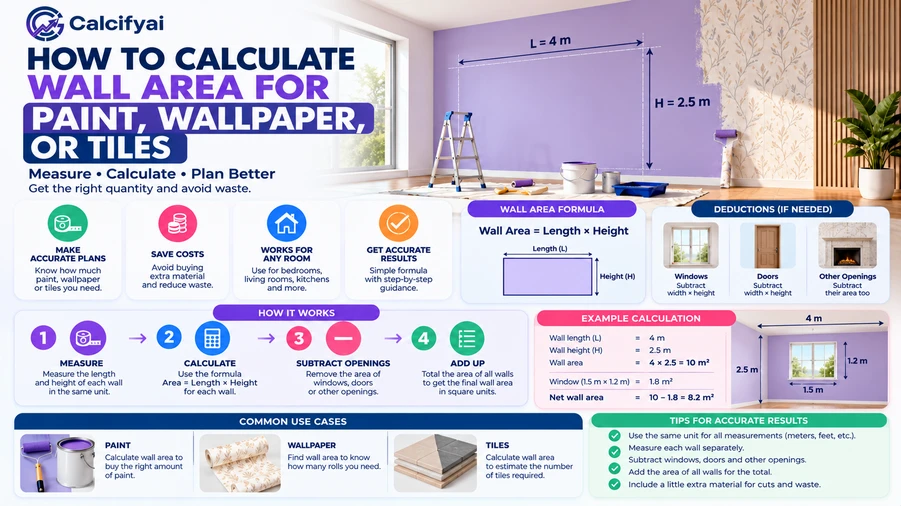
To calculate the area of a rectangular wall, use this formula:
Wall Area = Wall Width × Wall Height
If you have multiple walls, calculate each wall separately and add the areas together.
Total Wall Area = Area of Wall 1 + Area of Wall 2 + Area of Wall 3 + ...
For a room with four walls of equal height, you can also use:
Total Wall Area = Room Perimeter × Wall Height
If you are not painting, wallpapering, or tiling the entire surface, subtract the area of the openings or sections you want to leave uncovered.
Quick Example
Suppose a wall is 15 feet wide and 8 feet high.
Wall Area = 15 × 8
Wall Area = 120 square feet
The wall has a total surface area of 120 square feet (ft²).
How to Calculate Wall Area Step by Step
Follow these steps to measure a wall accurately before starting your project.
Step 1: Measure the Wall Width
Use a measuring tape to measure the horizontal distance from one side of the wall to the other.
For example:
- Wall width = 14 feet
For an uneven or angled wall, measure its sections separately instead of treating the entire surface as one rectangle.
Step 2: Measure the Wall Height
Measure the vertical distance from the floor to the ceiling, or to the height where your paint, wallpaper, or tiles will stop.
For example:
- Wall height = 9 feet
If you are installing a tile backsplash or adding wallpaper to only part of a wall, measure just the section you intend to cover.
Step 3: Multiply Width by Height
Use the wall area formula:
Wall Area = Width × Height
For the example above:
14 × 9 = 126 ft²
The total wall area is 126 square feet.
Step 4: Measure Doors and Windows
Doors and windows take up space that may not need paint, wallpaper, or tiles.
Measure the width and height of each opening and calculate its area.
For example:
Door: 3 ft × 7 ft = 21 ft²
Window: 4 ft × 3 ft = 12 ft²
Total opening area:
21 + 12 = 33 ft²
Step 5: Subtract the Openings
Subtract the total opening area from the wall area.
Net Wall Area = Total Wall Area − Opening Area
126 − 33 = 93 ft²
Final wall area = 93 square feet.
This is the estimated area available for covering, assuming the openings will remain uncovered.
How to Calculate the Total Wall Area of a Room
When painting or covering an entire room, you usually need to calculate the area of all four walls.
If the room is rectangular and all walls have the same height, use the room perimeter method.
Total Wall Area = 2 × (Room Length + Room Width) × Wall Height
Example: Calculate Wall Area for a Bedroom
Suppose a bedroom has these dimensions:
Length = 15 feet
Width = 12 feet
Height = 9 feet
First, calculate the room perimeter:
2 × (15 + 12) = 54 feet
Next, multiply the perimeter by the wall height:
54 × 9 = 486 ft²
The total wall area is 486 square feet.
If the bedroom has one door measuring 3 × 7 feet and two windows measuring 4 × 3 feet each:
Door area = 21 ft²
Two windows = 2 × 12 = 24 ft²
Total openings = 45 ft²
Subtract the openings:
486 − 45 = 441 ft²
The estimated net wall area is 441 square feet.
This method works when the room has a regular rectangular layout and consistent wall height. For rooms with sloped ceilings, alcoves, or unusual layouts, calculate each wall section separately.
How to Calculate Wall Area for Paint
Once you know the net wall area, you can estimate how much paint you need.
Use this formula:
Paint Needed = Net Wall Area ÷ Coverage per Gallon × Number of Coats
The coverage per gallon depends on the paint product and the wall surface. Check the paint can or manufacturer's instructions for its stated coverage.
Example: Estimate Paint for a Room
Suppose your room has:
Net wall area = 441 ft²
Paint coverage = 350 ft² per gallon
Number of coats = 2
First, calculate the paint needed for one coat:
441 ÷ 350 ≈ 1.26 gallons
For two coats:
1.26 × 2 ≈ 2.52 gallons
You would need approximately 2.52 gallons based on the stated coverage. Since paint is usually sold in set container sizes, you may need to purchase more than this calculated amount.
Keep in mind that rough, porous, or previously unpainted walls may absorb more paint. A major color change may also require extra coats.
How to Calculate Wall Area for Wallpaper
Wallpaper is usually sold in rolls, so you need the wall area and the coverage information for the specific wallpaper you plan to buy.
Start by calculating the net wall area. Then check the coverage per roll and account for pattern matching, trimming, and installation waste.
Example: Estimate Wallpaper for a Wall
Suppose a wall measures:
Width = 16 feet
Height = 9 feet
One window = 4 feet × 3 feet
Calculate the total wall area:
16 × 9 = 144 ft²
Calculate the window area:
4 × 3 = 12 ft²
Subtract the window:
144 − 12 = 132 ft²
If the wallpaper packaging states that one roll covers 50 square feet:
132 ÷ 50 = 2.64 rolls
You would need at least 3 rolls based on the stated coverage, but pattern repeats and trimming may require additional material. Check the manufacturer's guidance before purchasing.
How to Calculate Wall Area for Tiles
Wall tile projects use the same basic area formula. Measure the width and height of each section you plan to tile, then add the areas together.
For a wall with openings, subtract the sections that will not receive tiles, where appropriate.
Example: Calculate Tiles for a Bathroom Wall
Suppose you want to tile two bathroom walls:
Wall 1 = 10 feet wide × 8 feet high
Wall 2 = 6 feet wide × 8 feet high
Calculate the area of each wall:
Wall 1 = 10 × 8 = 80 ft²
Wall 2 = 6 × 8 = 48 ft²
Add the areas:
80 + 48 = 128 ft²
The total area to tile is 128 square feet before subtracting any openings.
If each tile measures 12 inches × 12 inches, each tile covers 1 square foot.
128 ÷ 1 = 128 tiles
This is the basic tile count before allowing for cuts, breakage, layout adjustments, and waste. For a more detailed estimate, use the Tile Calculator to enter your surface dimensions and tile size.
Using an Online Calculator to Find Wall Area
If you have several walls to measure or need to estimate material quantities, an online tool can make the calculation easier.
The Square Footage Calculator can help calculate surface areas for projects such as painting, wallpapering, and tiling. For walls with windows, its wall-related options can also help account for openings.
Before entering your measurements:
Measure the width and height of each wall.
Keep all measurements in compatible units.
Record the size of doors and windows.
Decide whether you need the total area or the net area after subtracting openings.
Check material coverage and waste recommendations separately.
For a broader explanation of how area and perimeter differ in room measurements, read area vs. perimeter.
Common Mistakes to Avoid When Calculating Wall Area
Even a small measurement error can affect how much material you buy. Watch out for these common mistakes.
Forgetting to Subtract Doors and Windows
If you are not covering the areas occupied by doors or windows, subtract their areas for a more precise estimate. For a rough paint estimate, some people leave small openings included to provide a little extra allowance.
Measuring Only One Wall
When covering an entire room, remember to include every wall that needs paint, wallpaper, or tiles. Measure each wall separately if the room has different wall lengths or heights.
Mixing Measurement Units
Do not multiply a wall width in feet by a height in inches without converting one measurement first.
For example, convert 96 inches to 8 feet before multiplying it by a width measured in feet.
Confusing Wall Area With Floor Area
Floor area measures the surface of the floor. Wall area measures the vertical surfaces.
A room's floor area alone does not tell you how much wall space needs to be covered. Wall height and the room's perimeter are also important.
Ignoring Material Coverage and Waste
Wall area and material quantity are not the same thing. Paint may need multiple coats, wallpaper may require pattern matching, and tiles may need extra pieces for cuts or breakage.
Always check product coverage and installation guidance rather than buying materials based only on the surface-area result.
Frequently Asked Questions
What Is the Formula for Calculating Wall Area?
For a rectangular wall, use:
Wall Area = Width × Height
For a room with four walls of equal height:
Total Wall Area = 2 × (Length + Width) × Height
Subtract doors and windows if you need the net area to be covered.
How Do I Calculate Wall Area in Square Feet?
Measure the wall's width and height in feet, then multiply them.
For example:
12 ft × 8 ft = 96 ft²
The wall area is 96 square feet.
How Do I Calculate Wall Area for a Room With Four Walls?
Add the widths of all four walls and multiply the total by the wall height.
For a rectangular room, you can use:
Total Wall Area = 2 × (Length + Width) × Height
Subtract the area of any openings you do not plan to cover.
Should I Subtract Doors and Windows When Calculating Wall Area?
Yes, if you want to estimate the area that will actually receive paint, wallpaper, or tiles. Measure each opening and subtract its area from the total wall area.
For a rough estimate, you may choose not to subtract small openings, depending on the project and the material.
How Much Paint Do I Need for 100 Square Feet of Wall?
The amount depends on the paint's coverage and the number of coats.
For example, if the paint covers 350 square feet per gallon, 100 square feet for one coat requires:
100 ÷ 350 ≈ 0.29 gallons
For two coats, the estimate is approximately 0.58 gallons. Check the product label and allow for the condition of the wall.
How Do I Calculate Wall Area for an Irregular Wall?
Divide the wall into smaller, familiar shapes, such as rectangles and triangles. Calculate each section's area and add the results together. Subtract any openings that will remain uncovered.
Is Wall Area the Same as Square Footage?
Wall area is a type of square footage measurement. It describes the surface area of a wall, while the term square footage can refer to many surfaces, including floors, walls, ceilings, and other spaces.
Conclusion
Calculating wall area is an important first step when planning a painting, wallpapering, or tiling project. Measure the width and height of each wall, multiply them to find the individual areas, and add the results together. Subtract doors and windows when you need the net area.
Once you have the total, use the product's coverage information to estimate how much paint, wallpaper, or tile to purchase. Accurate measurements and a reasonable allowance for waste can help you plan your project and avoid unnecessary material costs.
For additional guidance on area formulas and measurement methods, the National Institute of Standards and Technology's area calculation resource explains basic formulas and why measurements should use consistent units.
Disclaimer
The information provided in this article is for educational and informational purposes only. It should not be considered as professional financial, medical, or legal advice. Always consult with qualified professionals for specific guidance related to your situation.
Popular Calculators
Explore our most-used free calculators for finance, health, and everyday needs.