
How to Find Equivalent Ratios Using Multiplication and Division
Learn how to find equivalent ratios using multiplication and division with simple formulas, examples, and step-by-step methods.
Calcifyai Team
Expert calculators & financial tools
Equivalent ratios are ratios that show the same relationship between quantities, even though their numbers may be different.
For example:
2:3 = 4:6 = 6:9 = 10:15
These ratios look different, but they all represent the same relationship.
If you want to learn how to find equivalent ratios, the main rule is simple:
Multiply or divide both parts of a ratio by the same nonzero number.
This guide explains how the method works, how to check your answer, and how to use equivalent ratios in everyday problems.
What Is an Equivalent Ratio?
Two ratios are equivalent when they represent the same comparison.
For example:
3:5
and
6:10
are equivalent because both parts of the first ratio were multiplied by 2:
3 × 2 = 6
5 × 2 = 10
So:
3:5 = 6:10
Equivalent ratios are closely connected to proportions. OpenStax explains that when two ratios are equal, they form a proportion and can be used to solve scaling and comparison problems. OpenStax
How to Find Equivalent Ratios
There are two basic methods:
Multiply both parts by the same number.
Divide both parts by the same number.
The important rule is that you must perform the same operation on both parts.
For a ratio:
a:b
an equivalent ratio can be created by:
(a × k):(b × k)
where k is the same nonzero number for both parts.
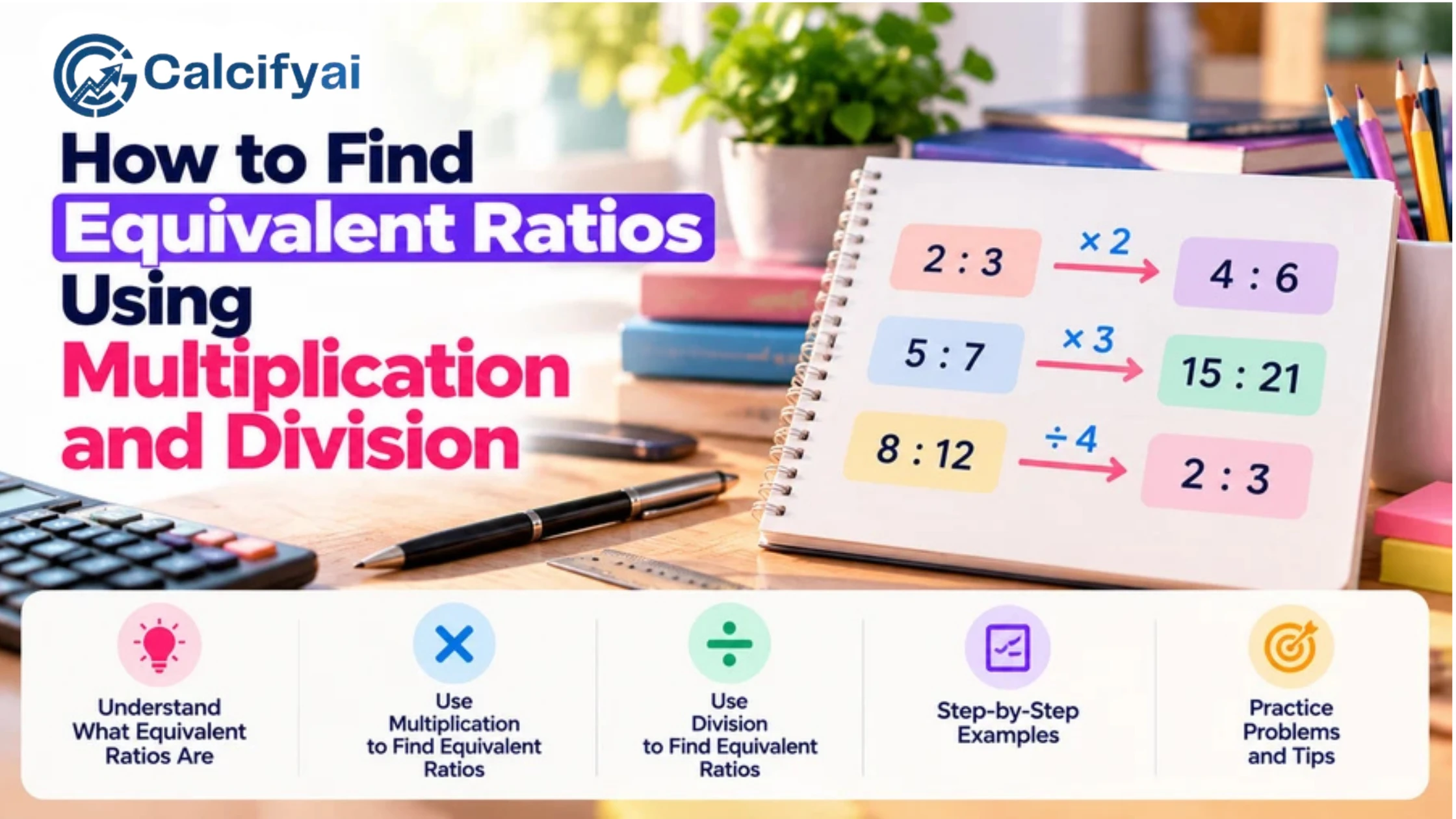
two ratios are equivalent when they represent the same comparison, even if the numbers are different. For example, 2:3 = 4:6 because both parts of the first ratio are multiplied by 2. This is the basic idea behind equivalent ratios: changing both parts by the same factor keeps the relationship unchanged.
Method 1: Multiply Both Parts of the Ratio
Multiplication is useful when you want to make a ratio larger while keeping the same relationship.
Example: Find an Equivalent Ratio for 2:5
Start with:
2:5
Multiply both parts by 3:
2 × 3 = 6
5 × 3 = 15
Therefore:
2:5 = 6:15
Both ratios represent the same relationship.
Another Example
Find an equivalent ratio for:
4:7
Multiply both parts by 2:
4 × 2 = 8
7 × 2 = 14
So:
4:7 = 8:14
You could also multiply by 3:
4 × 3 = 12
7 × 3 = 21
Therefore:
4:7 = 12:21
There are infinitely many equivalent ratios because you can continue multiplying by different positive numbers.
Method 2: Divide Both Parts of the Ratio
Division works when both parts have a common factor.
Example: Simplify 12:18
Start with:
12:18
Both numbers can be divided by 6:
12 ÷ 6 = 2
18 ÷ 6 = 3
Therefore:
12:18 = 2:3
The ratio 2:3 is an equivalent ratio in simplified form.
Another Example
Consider:
20:30
Divide both parts by 10:
20 ÷ 10 = 2
30 ÷ 10 = 3
So:
20:30 = 2:3
Division is especially useful when you want to reduce a ratio to its simplest form.
Step-by-Step: How to Find Equivalent Ratios
Use these simple steps.
Step 1: Write the Original Ratio
Suppose the ratio is:
5:8
Step 2: Choose a Multiplier or Divisor
Choose a number such as 2.
Step 3: Apply It to Both Parts
Multiply both values by 2:
5 × 2 = 10
8 × 2 = 16
Step 4: Write the New Ratio
10:16
Therefore:
5:8 = 10:16
Step 5: Check the Relationship
Simplify 10:16 by dividing both numbers by 2:
10 ÷ 2 = 5
16 ÷ 2 = 8
You get the original ratio:
5:8
So the ratios are equivalent.
How to Find an Equivalent Ratio With a Missing Number
Sometimes one part of the equivalent ratio is unknown.
For example:
3:4 = 9:x
You need to find x.
Look at the first values:
3 → 9
The multiplier is:
3 × 3 = 9
Use the same multiplier on 4:
4 × 3 = 12
Therefore:
x = 12
The completed ratio is:
3:4 = 9:12
Another Example
Suppose:
5:6 = x:24
Look at the second values:
6 → 24
Since:
6 × 4 = 24
multiply the first value by 4:
5 × 4 = 20
Therefore:
x = 20
So:
5:6 = 20:24
How to Find Equivalent Ratios by Division
Suppose you have:
36:48
You want a smaller equivalent ratio.
Find a number that divides both values.
Both 36 and 48 are divisible by 12:
36 ÷ 12 = 3
48 ÷ 12 = 4
Therefore:
36:48 = 3:4
This is the simplest form because 3 and 4 have no common factor greater than 1.
How to Find Equivalent Ratios With Fractions
Ratios can also contain fractions.
Consider:
1/2 : 3/4
To make the numbers easier to compare, multiply both parts by 4:
1/2 × 4 = 2
3/4 × 4 = 3
So:
1/2 : 3/4 = 2:3
The relationship has not changed; only the form of the ratio has changed.
How to Find Equivalent Ratios With Decimals
The same multiplication and division rule works with decimals.
Suppose you have:
2.5:4
Multiply both parts by 2:
2.5 × 2 = 5
4 × 2 = 8
Therefore:
2.5:4 = 5:8
You can then work with the whole-number ratio 5:8, which may be easier to use.
Real-Life Examples of Equivalent Ratios
Equivalent ratios are useful because the same relationship often needs to be represented with different quantities.
Example 1: Recipe
A recipe uses a ratio of:
2 cups flour : 3 cups milk
If you double the recipe, multiply both parts by 2:
2 × 2 = 4
3 × 2 = 6
The new ratio is:
4:6
So:
2:3 = 4:6
The recipe still has the same proportion of flour to milk.
Example 2: Students
A classroom has a ratio of:
3 boys : 5 girls
If the same ratio applies to a larger group, multiply both parts by 4:
3 × 4 = 12
5 × 4 = 20
The equivalent ratio is:
12:20
Example 3: Paint Mixture
Suppose blue and white paint are mixed in a ratio of:
2:7
To make a larger batch, multiply both parts by 5:
2 × 5 = 10
7 × 5 = 35
The new ratio is:
10:35
The mixture keeps the same relationship between blue and white paint.
Equivalent Ratios vs. Simplified Ratios
These ideas are related, but they work in opposite directions.
Equivalent Ratio by Multiplication
Start with:
2:3
Multiply by 4:
8:12
So:
2:3 = 8:12
Simplified Ratio by Division
Start with:
8:12
Divide by 4:
2:3
So:
8:12 = 2:3
Multiplication can make a ratio larger, while division can reduce it.
How to Check if Two Ratios Are Equivalent
There are several ways to check.
Method 1: Simplify Both Ratios
Suppose you want to compare:
6:9
and
10:15
Simplify the first:
6 ÷ 3 = 2
9 ÷ 3 = 3
So:
6:9 = 2:3
Simplify the second:
10 ÷ 5 = 2
15 ÷ 5 = 3
Both become:
2:3
Therefore, they are equivalent.
Method 2: Compare Cross Products
For:
a:b = c:d
multiply across:
a × d
and:
b × c
If the two products are equal, the ratios are equivalent.
For example:
2:3 and 8:12
Check:
2 × 12 = 24
3 × 8 = 24
Because both products equal 24, the ratios are equivalent.
Common Mistakes When Finding Equivalent Ratios
1. Changing Only One Number
Incorrect:
2:3 → 4:3
Only the first number was multiplied.
Correct:
2:3 → 4:6
Both parts must be multiplied by the same number.
2. Using Different Multipliers
Incorrect:
3 × 2 = 6
5 × 3 = 15
This produces 6:15, which is not equivalent to 3:5.
The multiplier must be the same.
3. Dividing Only One Part
Incorrect:
12:18 → 6:18
Only one value was divided.
Correct:
12:18 → 6:9
Both values are divided by 2.
4. Reversing the Ratio
Remember:
2:3
is not the same as:
3:2
The order of quantities matters.
5. Mixing Units
Before creating or comparing ratios, make sure the quantities use compatible units.
For example, don't directly compare:
2 meters : 50 centimeters
Convert the units first:
200 centimeters : 50 centimeters
Then simplify:
4:1
Quick Formula for Equivalent Ratios
For an original ratio:
a:b
multiply both parts by the same number k:
Equivalent Ratio = (a × k):(b × k)
For example:
3:4
Using k = 5:
(3 × 5):(4 × 5) = 15:20
So:
3:4 = 15:20
To simplify a ratio, divide both parts by the same common factor:
Equivalent Ratio = (a ÷ k):(b ÷ k)
as long as k divides both values evenly.
Use a Ratio Calculator
If you need to simplify a ratio, find equivalent ratios, or check a proportion, you can use the Ratio Calculator. It can simplify ratios and show scaled versions while helping you understand how the quantities relate to each other.
Frequently Asked Questions
How do you find equivalent ratios?
Multiply or divide both parts of the ratio by the same nonzero number. For example, multiplying 2:3 by 4 gives 8:12.
What is an example of an equivalent ratio?
Examples include:
2:3 = 4:6 = 6:9 = 8:12
Each ratio represents the same relationship.
Can you divide to find an equivalent ratio?
Yes. Divide both parts by the same common factor. For example:
18:24 ÷ 6 = 3:4
So 18:24 and 3:4 are equivalent.
Can you multiply a ratio by any number?
You can multiply both parts by the same nonzero number. For basic positive ratios, using the same positive multiplier preserves the ratio.
How do you know if two ratios are equivalent?
Simplify both ratios or compare their cross products. If they reduce to the same ratio or their cross products are equal, they are equivalent.
Is 4:6 equivalent to 2:3?
Yes. Divide both parts of 4:6 by 2:
4 ÷ 2 = 2
6 ÷ 2 = 3
Therefore:
4:6 = 2:3
What happens if you multiply only one part of a ratio?
The ratio changes and is generally no longer equivalent to the original ratio. Both parts must be multiplied or divided by the same number.
Conclusion
Learning how to find equivalent ratios comes down to one key rule: perform the same multiplication or division on both parts of the ratio.
For example:
3:5 × 2 = 6:10
and:
12:20 ÷ 4 = 3:5
The relationship stays the same even though the numbers change.
Once you understand this rule, you can use equivalent ratios to scale recipes, compare quantities, solve proportions, work with maps, and handle many everyday math problems.
Disclaimer
The information provided in this article is for educational and informational purposes only. It should not be considered as professional financial, medical, or legal advice. Always consult with qualified professionals for specific guidance related to your situation.
Popular Calculators
Explore our most-used free calculators for finance, health, and everyday needs.